Tuning advice
Does every vehicle go on the dyno?
How dyno development, established calibrations and road testing work together at Boostech Bloemfontein.
The short answer
No. We have our own Cobra dyno at Boostech Bloemfontein, and our main platform development starts there. Once a calibration has been developed and tested, another suitable vehicle can benefit from that work without automatically needing its own full dyno session. We still check the individual vehicle and road-test the finished result.
Main development starts on the dyno
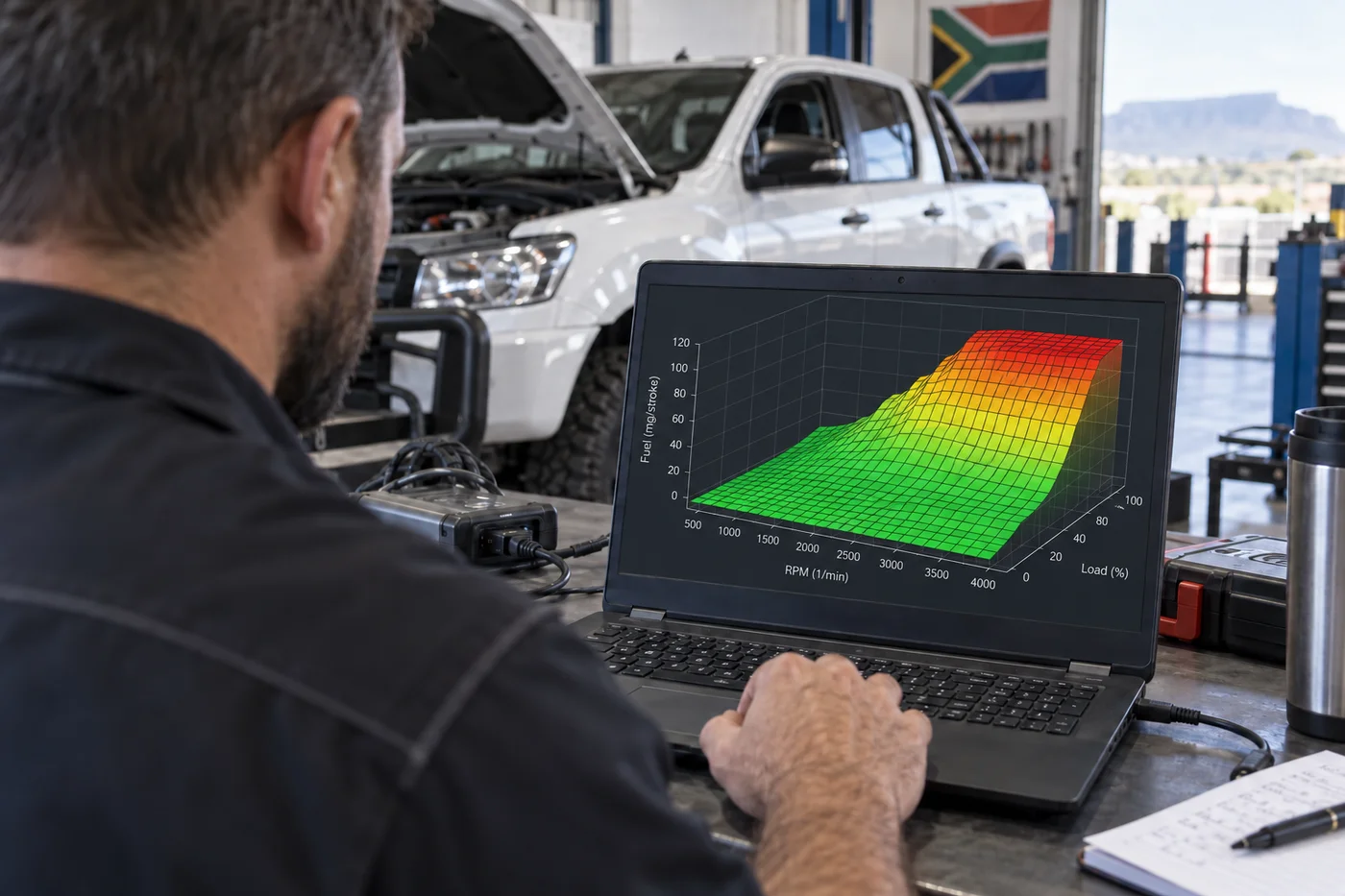
The dyno gives us baseline power and torque figures and a controlled way to measure the effect of calibration changes. We use it to develop new platforms, assess custom builds and compare before-and-after performance. Repeatable testing helps us understand where an improvement comes from.
A power graph is one part of the assessment. We also review operating data to see how the engine responds throughout the run, rather than judging a calibration only by its highest number.
Check what the engine actually delivers
A value requested in the software is not a guarantee of what the engine will deliver. Depending on operating conditions, a vehicle may not reach the requested boost or rail pressure, and commanded injection quantity or ECU-reported torque can differ from the intended calibration.
We compare requested and available actual or reported channels, including boost, rail pressure, injection quantity and torque-related values. The channels available depend on the ECU; reported quantities are not always direct physical measurements. This helps us see whether the vehicle follows the intended calibration and where further checking is needed.
Why road logs matter
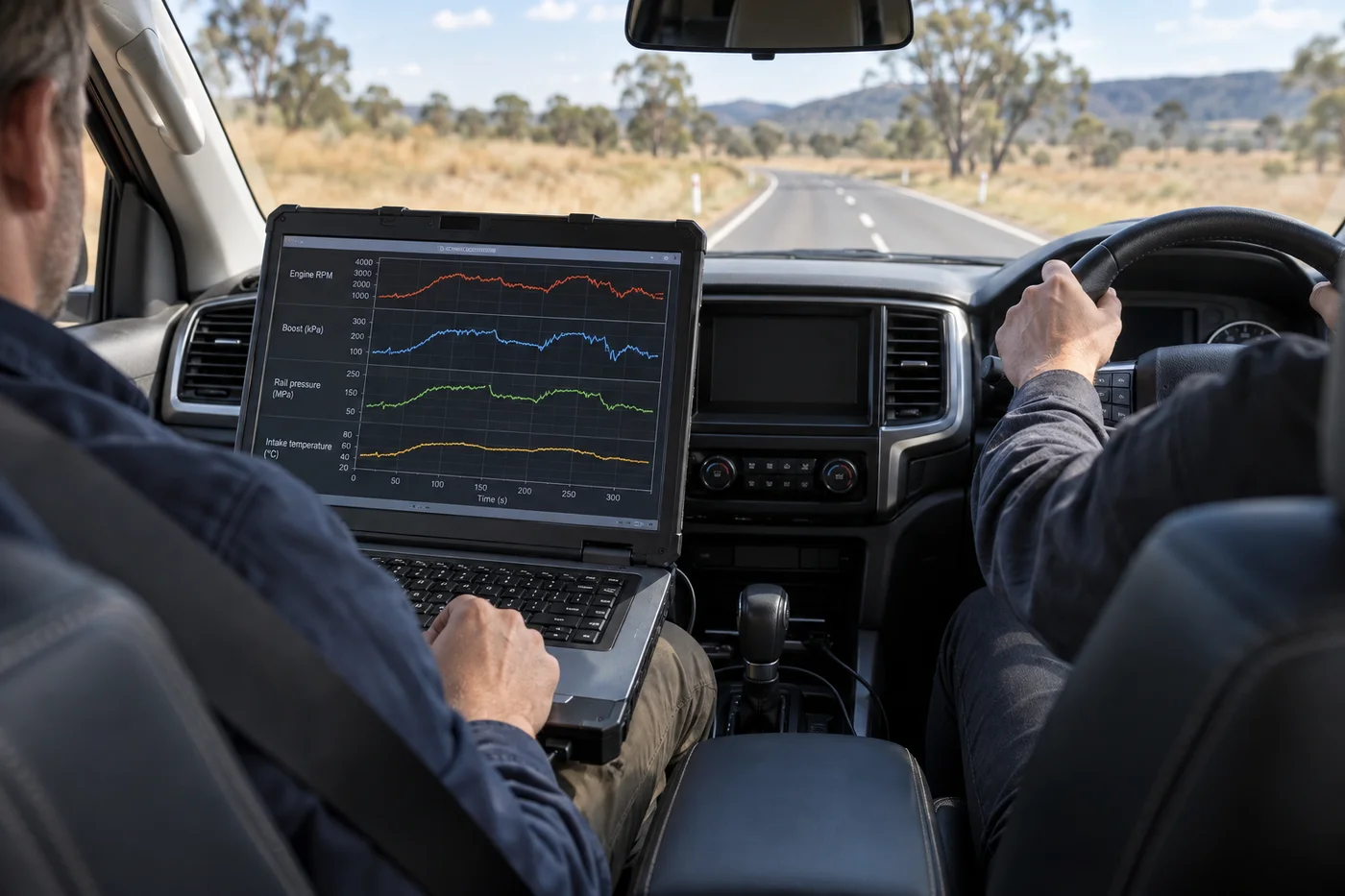
Road testing exposes the vehicle to the loads, gradients, airflow and temperature changes it encounters in everyday use. The time spent under load and the transitions between cruising and acceleration can also differ from a particular dyno run.
For questions about how the vehicle behaves on the road, those logs can provide a more representative picture than a workshop pull alone. We compare them with the dyno results to refine response and confirm performance under the conditions the vehicle actually operates in. Dyno and road testing each contribute useful information.
The gearbox is part of the result
On the road, we assess shift timing, kickdown, gear hunting, torque-converter lock-up and how smoothly the vehicle responds to changing accelerator input and gradients. We can also evaluate whether it holds a useful gear during normal driving and under suitable loads.
A dyno can support transmission testing, but a peak-power run does not capture the complete driving experience. Road testing lets us combine logged data with how the shifts feel in use, so engine and gearbox calibration work together.
What if I want my own power graph?
Tell Pieter when making your enquiry if you want individual before-and-after dyno measurements. We can include appropriate testing in your package. Our aim is a vehicle that delivers useful performance both on the graph and on the road.
Speak to Pieter
Send your vehicle or machine details and your location for advice and a quote.
Enquire with Boostech Bloemfontein